
Game analysis / Mechanics / Design thinking
Understand the game
Study Chess, Super Mario, Galaga and Dangerous Dave to see how rules, feedback, challenge and player choices create an experience.
HOW YOU LEARN
A studio-inspired learning experience where every new skill moves your project forward. Think critically. Build together. Refine through feedback.
Game analysis / Mechanics / Design thinking
Study Chess, Super Mario, Galaga and Dangerous Dave to see how rules, feedback, challenge and player choices create an experience.
Narrative / Character arcs / Book preparation
Develop an original idea into a team story of around 15,000–20,000 words. Build characters and a world bible, then prepare a book for KDP submission.
Concept art / Photoshop / Storyboards
Translate your writing into a visual language: references, AI-assisted concepts in Photoshop and 3D AI Studio, character sheets and storyboards. Practice continuity and composition.
Blender / Faceform Wrap / MetaTailor / Substance Painter
Move from 2D ideas to usable 3D assets — modelling, sculpting and rigging in Blender, facial topology in Faceform Wrap, clothing and outfitting in MetaTailor, and PBR texturing in Substance Painter.
Programming fundamentals / Unreal Engine (C++) / Stride (C#)
Learn the basics of programming — logic, variables and control structures — then build real gameplay in your chosen engine: C++ in Unreal Engine for RPG development, or C# in Stride for RTS development.
Playtesting / Optimization / Portfolio
Use playtesting to improve clarity, pacing and performance. Deliver a reliable packaged demo and explain your individual contribution.
Use tools like 3D AI Studio, Lychee Studio, Meshy AI and YVO3D to explore ideas and speed up early 3D work, then learn to evaluate, edit and integrate the results. Keep track of sources, permissions and your own decisions.
Collaborate on a shared project while documenting your role and showing the skills you can demonstrate independently.
A strong gameplay loop, a contained environment and a polished experience. Scope is a creative skill we practice from day one.
INSIDE THE PRODUCTION LAB
A closer look at the practice behind a polished demo. Illustrations show creative possibilities, not student results.
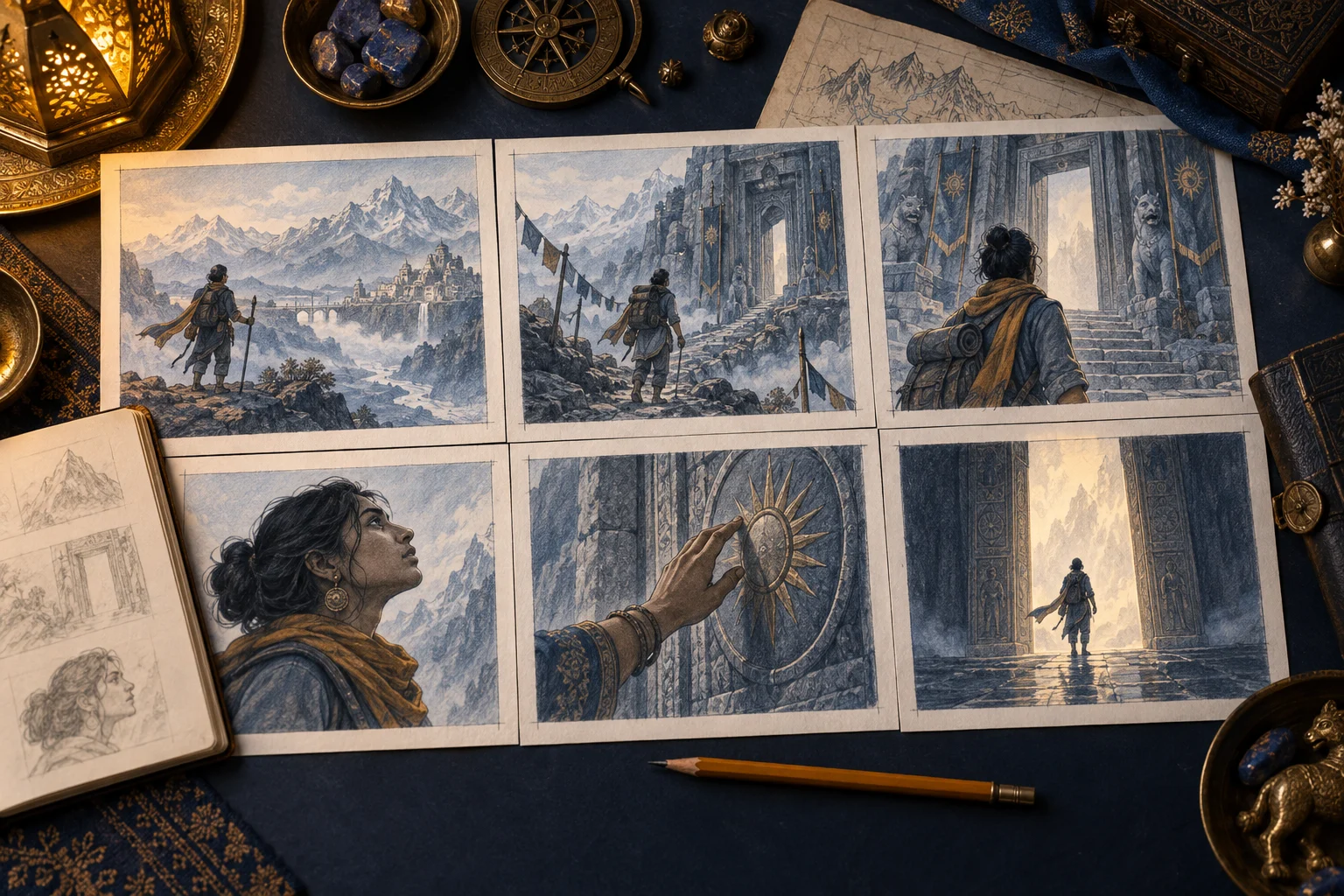
STORY → STORYBOARD → LEVEL
A written scene describes what happens. A storyboard explores how it is seen. A playable level asks what the player can do. Students learn to translate between all three, rather than turning a long story into an equally long cutscene.
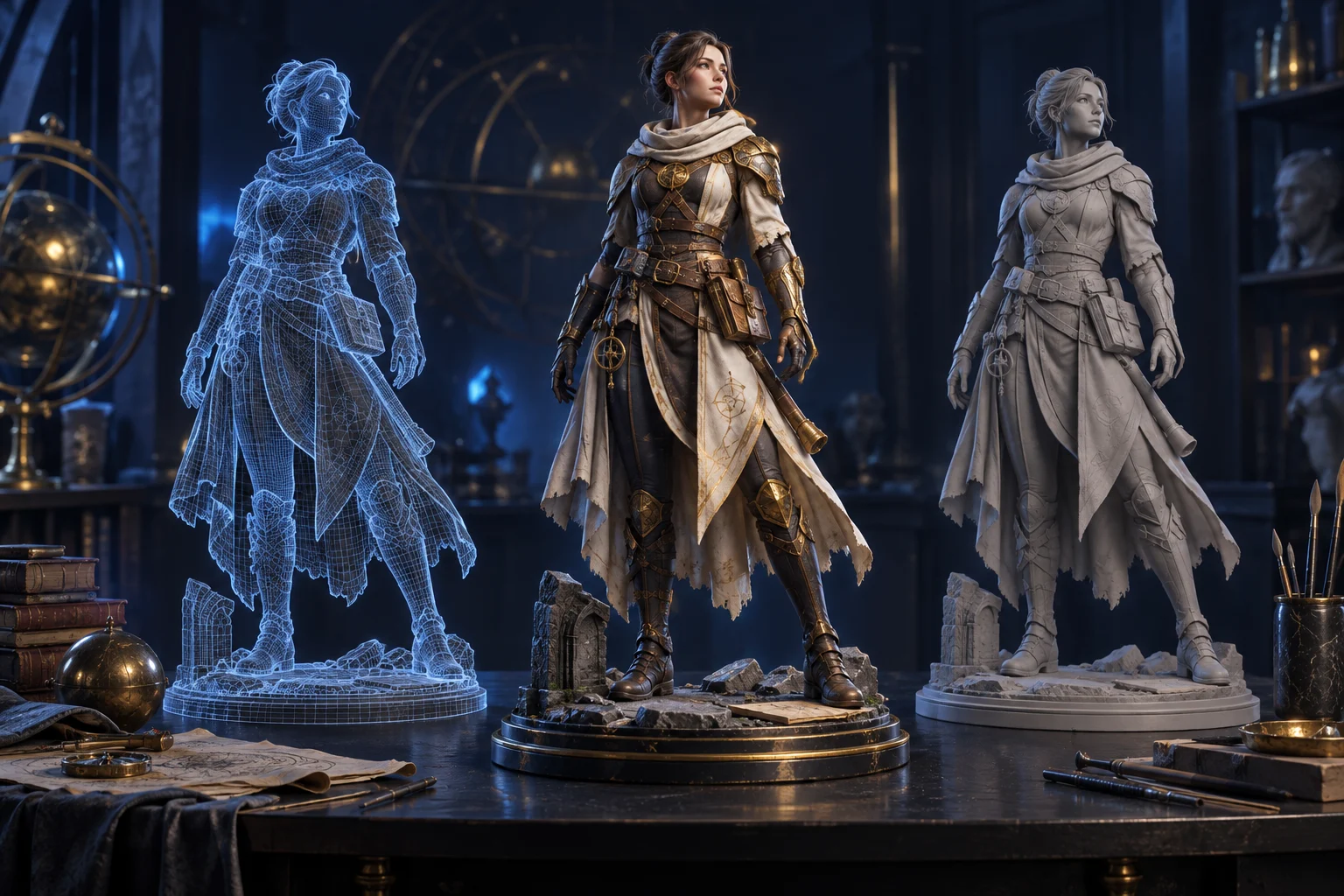
CONCEPT → ASSET → INTEGRATION
A striking concept image is not yet a usable game character. The production journey includes modelling, topology, UVs, materials, rigging, animation and engine integration. Not every specialist tool is needed for every asset.
THE WEEKLY BUILD LOOP
Can a new player find the exit? Does the interaction make sense? Can a character move through the space? Each exercise should answer something specific.
Bring a sketch, playable build or asset into a critique. Record what people actually struggled with, not only what you hoped they would notice.
Use dated builds, a simple task board and before-and-after captures. Document changes so your development process becomes part of your portfolio.
BEFORE YOUR FIRST SESSION
Workload, equipment, team roles, assessment and the questions worth asking before you enroll—all in one student guide.
Read the student guideYOUR NEXT CHAPTER STARTS HERE
Free registration of interest. No commitment.